ESCALAB QXi X-ray photoelectron spectrometer
Padua

Padua
 Photoelectron Spectroscopies (XPS and UPS) are key surface-sensitive techniques widely used in both applied research and industrial development.
XPS (X-ray photoelectron spectroscopy) provides elemental composition and chemical state information, enabling the identification of oxidation states, bonding environments, and surface contamination. It is extensively applied in materials science, catalysis, corrosion studies, semiconductor processing, and thin-film engineering. UPS (ultraviolet photoelectron spectroscopy) complements XPS by probing the valence band structure and electronic states close to the Fermi level. UPS is a central tool in the development of both inorganic and organic electronics, such as OLEDs, organic photovoltaics, hybrid perovskite-based devices and inorganic solar cells where energy level alignment at interfaces governs performance.
Together, XPS and UPS play a strategic role in advancing surface and interface science and materials across catalysis, semiconductors, energy, biomaterials, coatings, corrosion science and nanotechnology.
ESCALAB QXi X-ray photoelectron spectrometer is a multitechnique-platform for XPS, UPS, REELS and ISS spectroscopies equipped also with a dual mode ion gun for depth profile analysis.
XPS (X-ray photoelectron spectroscopy) provides the composition of the outer few nanometers of a material detailing and quantifying both the elements present and their chemical states. The main XPS features are:
-monochromatic Al/Ag source for large and small area XPS (mm2 – μm2)
-Al/Mg twin source non monochromatic
-magnetic lens
-flood gun for charge compensation
-ARXPS (angle resolved XPS)
-XPS parallel imaging (resolution 2-3 μm)

Depth profile of an oxidized Hadfield steel surface
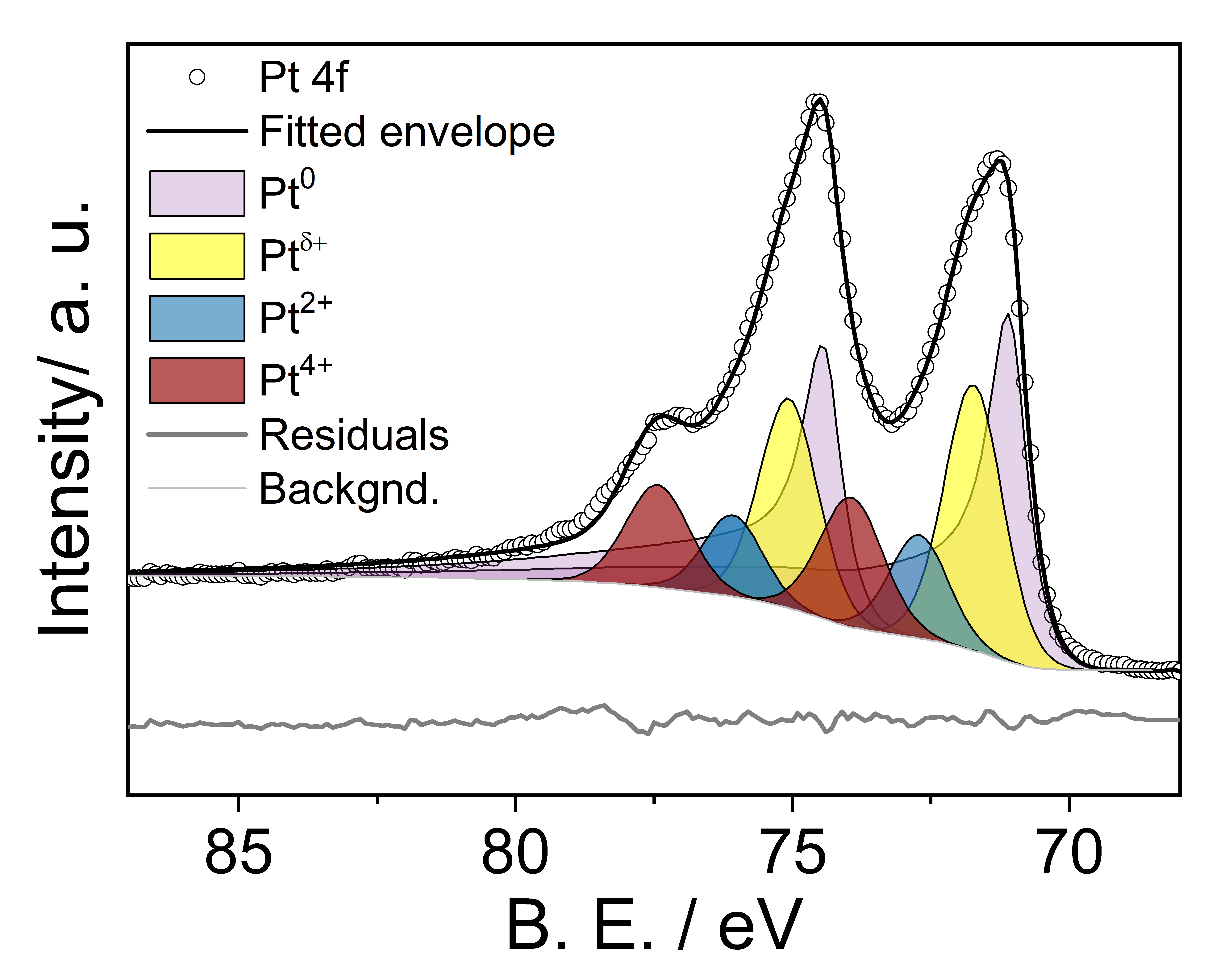
Fitting of the Pt 4f photoemission region for a Pt-based catalyst.
UPS (ultraviolet photoelectron spectroscopy) gives information on the valence band and it allows to determine the electronic work function, valence band maximum and ionization potential.
REELS (reflected electron energy loss spectroscopy) is a technique used to probe the electronic structure of the material at the surface (band gap, if > 2.5 eV). In some cases, it is also able to detect hydrogen, which is not possible with XPS.
ISS (ion scattering spectroscopy) is a highly surface-sensitive technique used to probe the elemental composition of the first atomic layer of a surface.
DUAL MODE ION GUN enables depth profiling of soft materials such as polymers and organic materials using gas cluster ions as well as of hard materials (metals and inorganics) using monatomic ions.
IM@IT research infrastructure network
The X-ray photoelectron spectroscope has recently joined the IM@IT research infrastructure network.
IM@IT is a multidisciplinary project that connects different scientific facilities and brings together research groups in Italy, Europe and worldwide. Initiated in 2019 with the ISIS@MACH project and launched in 2020, IM@IT has already attracted over a hundred users, with participants doubling in the last year, showing its potential to give rise to a new generation of collaborative researchers from both academia and industry and to be a game changer in the transformation of the research ecosystem in Italy and abroad.
IM@IT comprises a set of distributed laboratories, with MRFs offering open access tailored to the needs of academia and industrial user communities with appropriate peer review procedures and SRFs offering services.
If you want to know more follow the link below: https://isismachitalia.eu/
CONTACT