
OVERVIEW
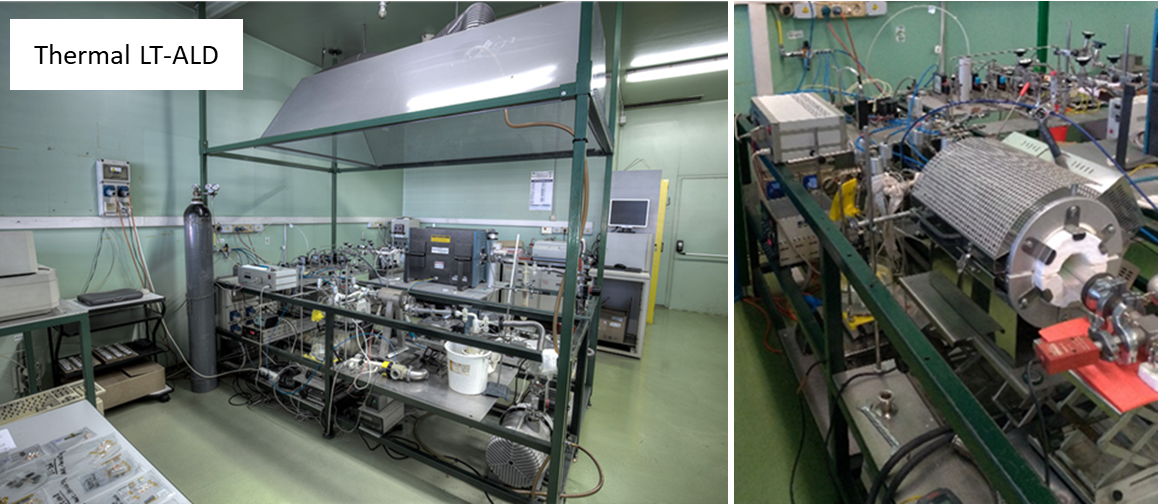
The Metal Organic Chemical Vapor Deposition (MOCVD) Lab at CNR-ICMATE of Padova hosts a custom-made Thermal-ALD apparatus, which provides atomic-level control over film thickness and composition, enabling the creation of highly uniform and conformal coatings on even complex 3D architectures.
How It Works
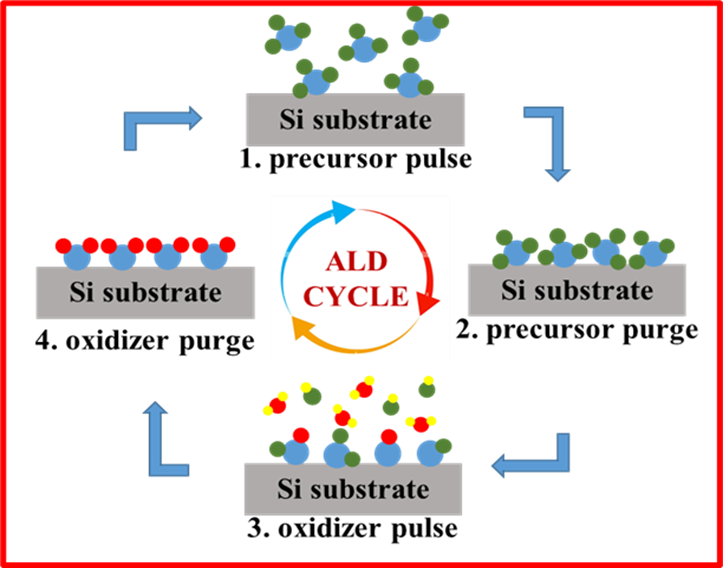
The ALD process relies on cyclic and sequential, self-limiting surface reactions. By pulsing precursors and reactants separately, we achieve:
- Conformal Growth: Uniform thickness over high-aspect-ratio structures and porous materials.
- Sub-Nanometer Control: Tailoring of coatings through a layer-by-layer deposition process.
- Low-Temperature Versatility: Our LT-ALD (Low-Temperature ALD) can operate from low to intermediate temperature (from RT up to 300°C) allowing for deposition on heat-sensitive substrates (i.e. hybrid organic-inorganic systems) and/or minimizing unwanted inter-diffusion film-substrate processes. It is suitable for the deposition of single- and multi-layers functional material for different purposes, especially for oxide-based compounds.
Some ALD applications: From Planar Films to 3D Architectures
The group is specialized in the synthesis of high-quality Titanium Dioxide (TiO2) showcased through diverse morphologies:
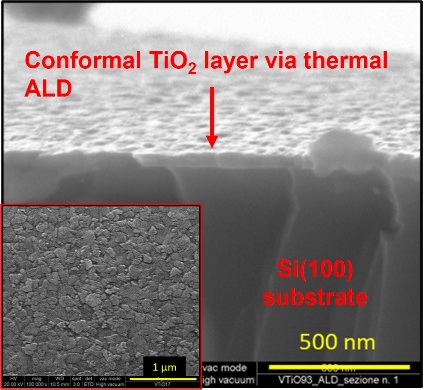
Highly-Conformal Layers for Bio-sensing
High-quality film deposition on Si(100) substrates, ensuring structural integrity at the nanoscale for biomedical applications.
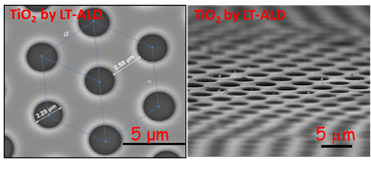
Ordered Micro-Patterning
High-precision TiO2 honey-comb arrays with controlled periodicity and morphology.
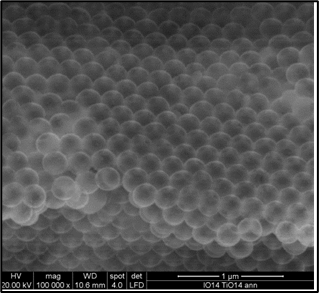
Hollow Nanospheres
3D nanostructures for high-surface-area applications.
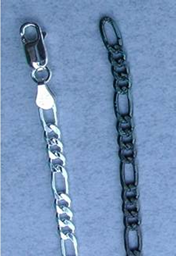
Protective coatings for advanced manufacturing
Development of functional oxide-based layers (single and/or multilayer) on gold or silver manufacts for increasing wear resistance and aging behavior, while preserving mechanical and aesthetic properties.
Metal Organic Chemical Vapor Deposition (MOCVD): Versatile Synthesis for Advanced Materials
Metal Organic Chemical Vapour Deposition (MOCVD) is a premier chemical process for deposition of both single- and multi-component nanostructured materials. By precisely controlling the chemical decomposition of specific precursors on heated substrates, high-quality films with tailored properties can be achieved.
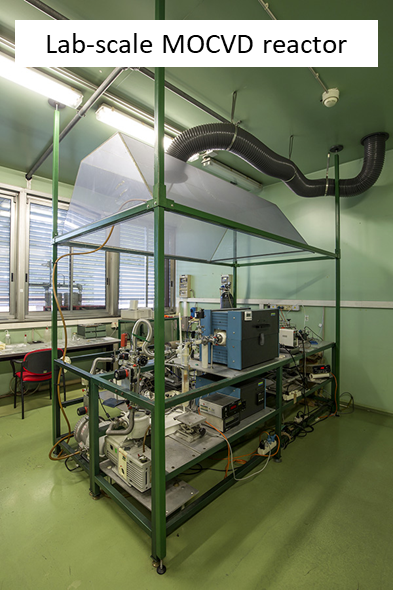
ICMATE-CNR of Padova hosts two custom-made hot-wall reactors designed to meet diverse experimental and industrial needs:
- Versatile Environment: With a vast array of adjustable physical and chemical parameters, we can tune the compositional, morphological, and structural characteristics of every film.
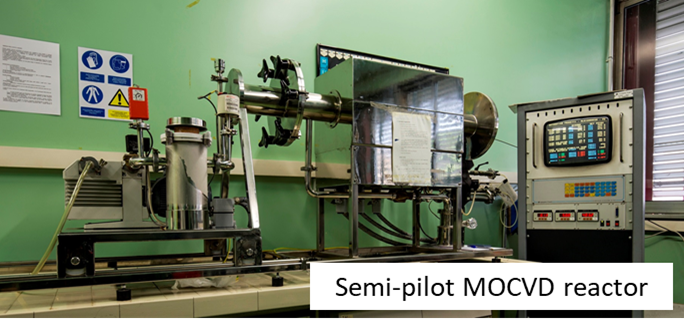
- Large-Scale Capability: A semi-pilot dedicated reactor is optimized for TiO2 large-area deposition, accommodating samples up to 10x40 cm.
Functionalization of Advanced Materials: A wide range of materials (crystalline or amorphous), for different advanced purposes such as energetic, (photo)catalysis, sensor, biomedical, electronic, protective or decorative applications, even on complex substrate shapes can be deposited.
Some MOCVD applications
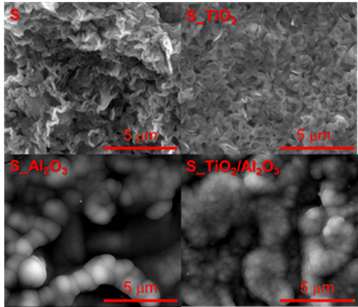
Barrier Protective coatings
Development of Hydrogen Permeation Barrier (HPB) coatings able to prevent the Hydrogen Embrittlement (HE) of metallic pipelines and tanks.
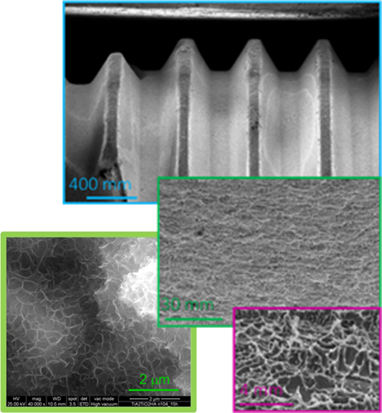
Enhancement of Functional Properties for Bio-Med
Crystalline, dense and compact TiO2 layers. Surface functionalization of medical implants to improve osteo-integration and service-life.
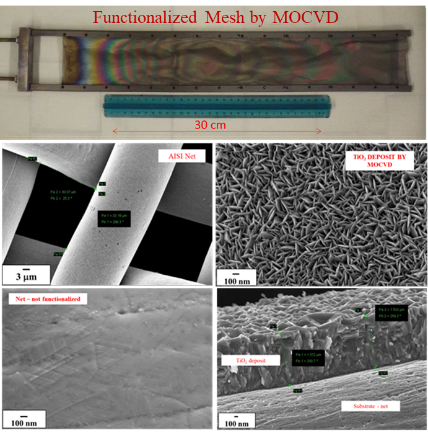
From Mesh to Nanostructure: TiO2 Deposition
Example of large-scale stainless-steel mesh functionalized by TiO2 film via MOCVD with enhanced photocatalytic properties for water remediation.
Cold-Wall MOCVD & PECVD Technology
The MOCVD Lab is also equipped with a Cold-Wall Metal Organic Chemical Vapour Deposition (MOCVD) reactor, custom-developed to operate under reduced pressure conditions.
Key Technical Features
- Advanced Precursor Handling: Introduction of solid, low-volatile, and air-sensitive chemical precursors through specialized evaporation cells.
- Precision Monitoring: Precursor cell-holders are integrated with feedback controls for strictly controlled deposition.
- High Thermal Efficiency: Reactions are localized exclusively on the heated substrate surface, minimizing precursor waste.
- Material Quality: Optimized to produce high-density, high-purity inorganic oxide-based materials.
- Dual-Mode Operation: Configuration as PECVD for functionalization of thermal-sensitive materials like plastics.
For further information, please contact:
Naida El Habra – naida.elhabra@cnr.it
ALD&MOCVD Lab
Padua
The Metal Organic Chemical Vapor Deposition (MOCVD) Lab at CNR-ICMATE of Padova hosts a custom-made Thermal-ALD apparatus, which provides atomic-level control over film thickness and composition, enabling the creation of highly uniform and conformal coatings on even complex 3D architectures.
How it works
The ALD process relies on cyclic and sequential, self-limiting surface reactions. By pulsing precursors and reactants separately, we achieve:
- Conformal Growth: Uniform thickness over high-aspect-ratio structures and porous materials.
- Sub-Nanometer Control: Tailoring of coatings through a layer-by-layer deposition process.
- Low-Temperature Versatility: Our LT-ALD (Low-Temperature ALD) can operate from low to intermediate temperature (from RT up to 300°C) allowing for deposition on heat-sensitive substrates (i.e. hybrid organic-inorganic systems) and/or minimizing unwanted inter-diffusion film-substrate processes. It is suitable for the deposition of single- and multi-layers functional material for different purposes, especially for oxide-based compounds.
Some ALD applications: From Planar Films to 3D Architectures
The group is specialized in the synthesis of high-quality Titanium Dioxide (TiO2) showcased through diverse morphologies:
Highly-Conformal Layers for Bio-sensing
High-quality film deposition on Si(100) substrates, ensuring structural integrity at the nanoscale for biomedical applications.
Ordered Micro-Patterning
High-precision TiO2 honey-comb arrays with controlled periodicity and morphology.
Hollow Nanospheres
3D nanostructures for high-surface-area applications.
Protective coatings for advanced manufacturing
Development of functional oxide-based layers (single and/or multilayer) on gold or silver manufacts for increasing wear resistance and aging behavior, while preserving mechanical and aesthetic properties.
Metal Organic Chemical Vapor Deposition (MOCVD): Versatile Synthesis for Advanced Materials
Metal Organic Chemical Vapour Deposition (MOCVD) is a premier chemical process for deposition of both single- and multi-component nanostructured materials. By precisely controlling the chemical decomposition of specific precursors on heated substrates, high-quality films with tailored properties can be achieved.
ICMATE-CNR of Padova hosts two custom-made hot-wall reactors designed to meet diverse experimental and industrial needs:
- Versatile Environment: With a vast array of adjustable physical and chemical parameters, we can tune the compositional, morphological, and structural characteristics of every film, operating at both atmospheric and reduced pressure to meet diverse research needs.
- Large-Scale Capability: A semi-pilot dedicated reactor is optimized for TiO2 large-area deposition, accommodating samples up to 10×40 cm.
Functionalization of Advanced Materials: A wide range of materials (crystalline or amorphous), for different advanced purposes such as energetic, (photo)catalysis, sensor, biomedical, electronic, protective or decorative applications, even on complex substrate shapes can be deposited.
Some MOCVD applications:
Barrier Protective coatings
Development of Hydrogen Permeation Barrier (HPB) coatings able to prevent the Hydrogen Embrittlement (HE) of metallic pipelines and tanks. CVD techniques can be used to prepare single layers, as well as multilayer systems.
Enhancement of Functional Properties for Bio-Med
Crystalline, dense and compact TiO2 layers. Surface functionalization of medical implants to improve osteo-integration and service-life. MOCVD ensures highly conformal coatings on Ti dental implant.
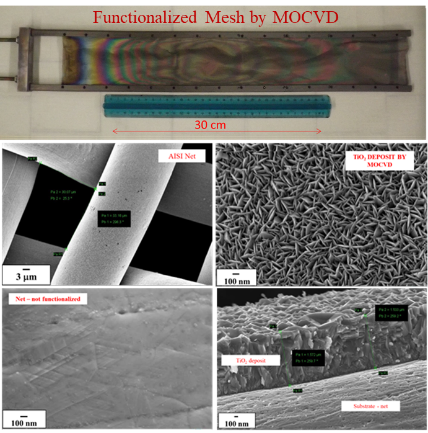
From Mesh to Nanostructure: TiO2 Deposition
Example of large-scale stainless-steel mesh functionalized by TiO2 film via MOCVD with enhanced photocatalytic properties for water remediation.
Cold-Wall MOCVD&PECVD Technology
The MOCVD Lab is also equipped with a Cold-Wall Metal Organic Chemical Vapour Deposition (MOCVD) reactor, custom-developed to operate under reduced pressure conditions. This system is engineered for maximum efficiency and precision in material growth.
Key Technical Features
- Advanced Precursor Handling: The system enables the direct introduction of solid, low-volatile, and air-sensitive chemical precursors through specialized evaporation cells.
- Precision Monitoring: Precursor cell-holders are integrated with feedback controls, allowing for real-time monitoring of precursor levels to ensure strictly controlled and reproducible deposition environments.
- High Thermal Efficiency: By utilizing the “cold-wall” configuration, chemical reactions are localized exclusively on the heated substrate surface. This minimizes precursor waste and prevents unwanted deposition on the reactor walls.
- Material Quality: The reactor is optimized to produce high-density, high-purity inorganic oxide-based materials.
- Dual-Mode Operation: The reactor versatility is further extended by its configuration as a Plasma Enhanced Chemical Vapour Deposition (PECVD) The precursors are activated by means of a “cold” Radio Frequency (RF) plasma (13.56 MHz) operating under low-pressure conditions. Plasma activation allows for high deposition rates at significantly lower temperatures compared to standard MOCVD process, allowing for functionalization of thermal-sensitive materials, such as plastic-based substrates, preventing thermal degradation or damage during the process.
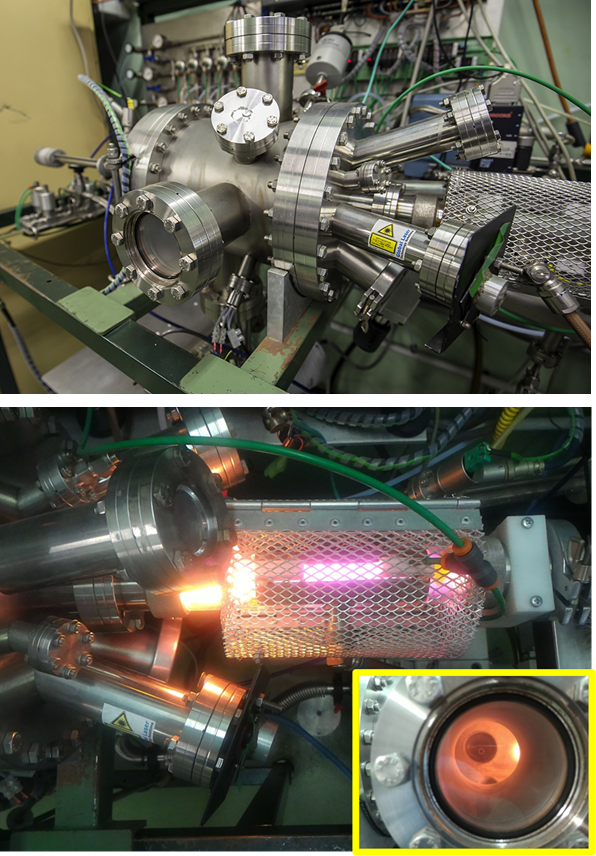
LP-CVD apparatus which operates as cold-wall MOCVD (upper) and PE-MOCVD equipped with an RF (13.56 MHz) capacity coupled device, which operates in-situ or in remote mode (lower).
CONTACT