
PADUA FACILITIES
NMR Spectroscopy Lab
The nuclear magnetic resonance spectroscopy lab at ICMATE-Padova hosts a Bruker Avance III 300 MHz (7.0 T) spectrometer for the analysis of liquids and solids.
NMR spectroscopy is a powerful tool to reveal the chemical structure of molecules investigating the connectivity between atoms and the presence of functional groups.

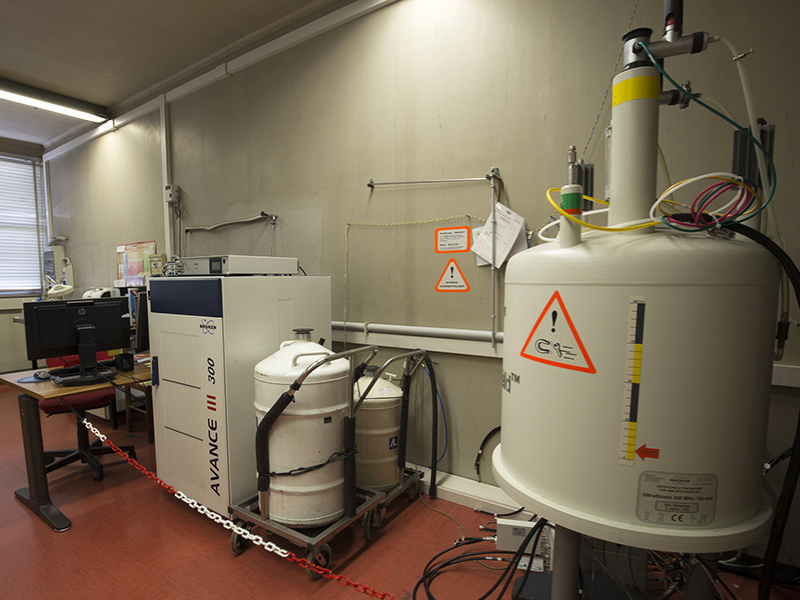
NMR signal is obtained from the decaying processes originating from excited nuclei in a magnetic field. Only NMR-active nuclei can be measured, with spin quantum number I > 0.
Applications include routine chemical identification, structural analysis, reaction kinetics, and molecular dynamics. It is used in:
- Organic and organometallic chemistry
- Inorganic and material chemistry
- Natural products and biochemistry
- Reaction kinetics and molecular dynamics
Analysis can be performed on liquid samples or solid samples (Solid State NMR - SSNMR) like powders and composite samples.
Technical Specifications
Equipment
- Avance III 300MHz spectrometer with Ultra Shield magnet
- 2 independent RF channels (100W for 1H-19F / 300W 31P-15N)
- Digital Temperature Control BSVT (-200°C to +400°C)
- Z field gradient spectroscopy (GRASP II)
Probes
- BBI 5mm (1H-13C-15N) high sensitivity for liquids
- BBFO 5mm with automatic tuning for liquids
- CP-MAS 4mm for solids (spinning up to 15KHz)
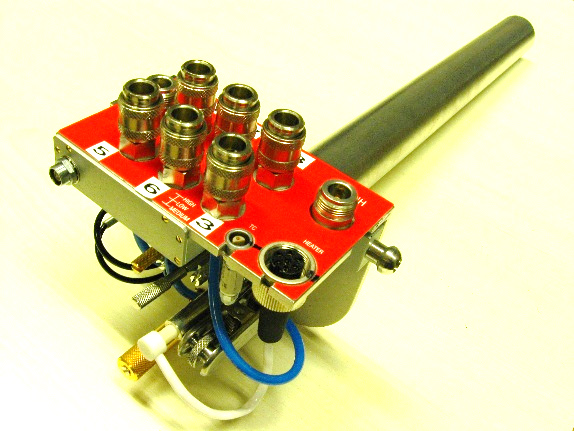
ICMATE NMR expertise includes the study of construction and building materials, natural clays, polymers, biopolymers and composites (nuclei: 1H, 13C, 29Si, 27Al, 31P). In the field of synthetic chemistry: identification of organic molecules and coordination compounds, 'fingerprint' determination of complex mixtures of natural products extracts and food derived matrices.
Some Spectra Examples
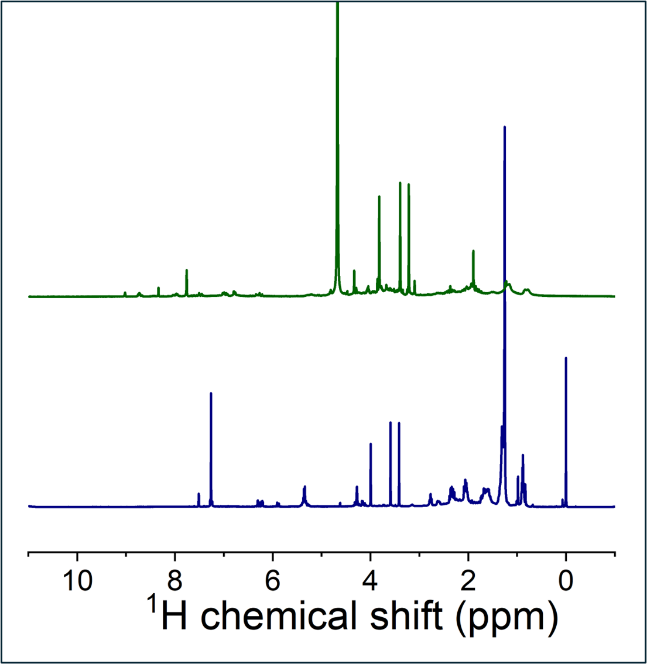
1H solution spectra of a commercial coffee powder extract dissolved in CDCl3 and D2O: lipids, which are soluble in chloroform, yield intense signals in CDCl3 (0-3 ppm region). Caffeine signals (3-4 ppm region) is visible in both CDCl3 and D2O.
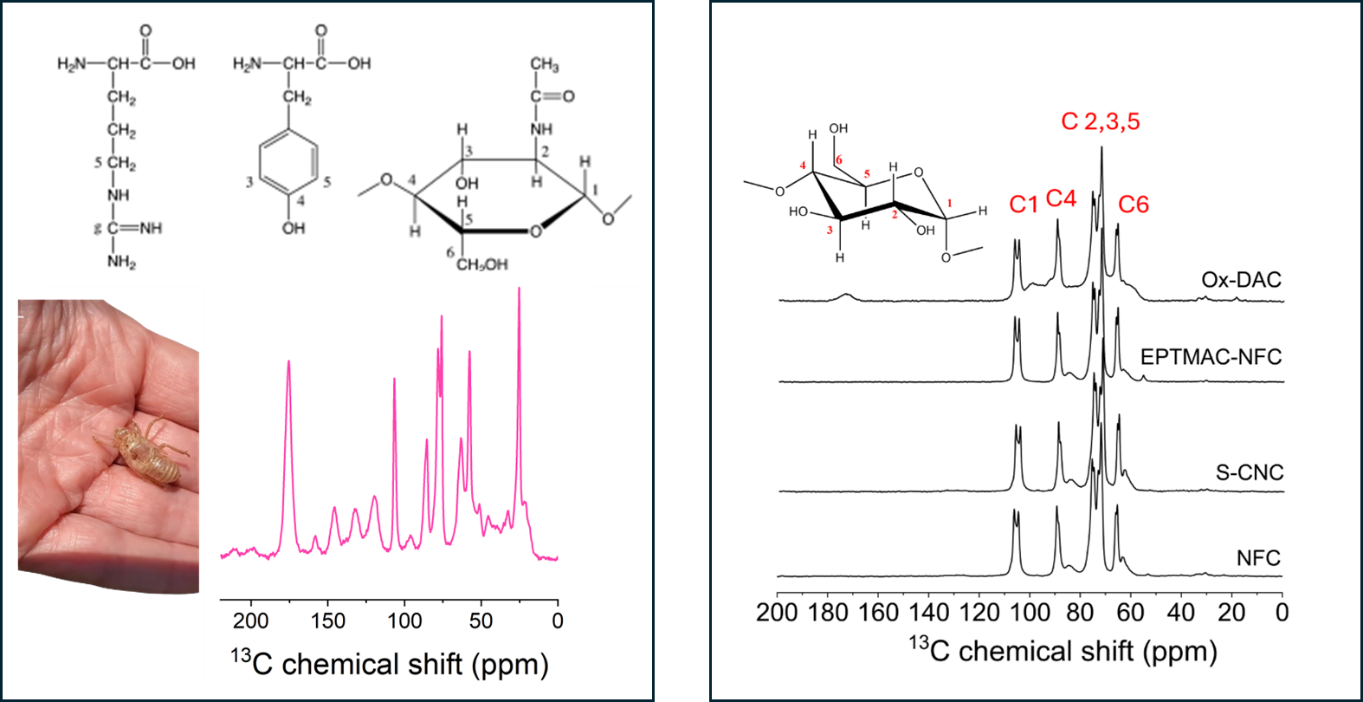
13C CP-MAS spectra of grounded cicada exuviae (left) and on functionalized celluloses (right).
Nuclear magnetic resonance spectroscopy (NMR)
Padua
BRUKER AVANCE III WORKING STATION
BRUKER AVANCE III MAGNET.
The nuclear magnetic resonance spectroscopy lab at ICMATE-Padova hosts a Bruker Avance III 300 MHz (7.0 T) spectrometer for the analysis of liquids and solids.
NMR spectroscopy is a powerful tool to reveal the chemical structure of molecules investigating the connectivity between atoms and the presence of functional groups.
NMR signal is obtained from the decaying processes originating from excited nuclei in a magnetic field. Only NMR-active nuclei can be measured, with spin quantum number I>0.
NMR spectroscopy has a wide range of applications: routine chemical identification, detailed compositional and structural analysis, investigation of chemical reactions kinetics, molecular dynamics.
It is used in several research fields:
- Organic and organometallic chemistry
- Inorganic and material chemistry
- Natural products and biochemistry
- Reaction kinetics and molecular dynamics
Routine NMR analysis are performed on liquid samples where the analyte is dissolved in deuterated solvents. However NMR can be recorded also on solid samples (Solid State NMR or SSNMR) such as crystalline powders but also amorphous materials, glasses and composite/heterogeneous samples.
OUR INSTRUMENT
EQUIPMENT
- Avance III 300MHz spectrometer with Ultra Shield magnet
- 2 indipendent RF channels with 100 Watt for 1H-19F / 300 Watt 31P-15N amplificators
- Digital Temperature Control BSVT -200°C +400°C
- Z field gradient spectroscopy (accessory GRASP II: 10 A amplificator)
- Pneumatic unit MAS
Our NMR is equipped with three probes:
- Probehead BBI 5mm with Z grad 1H-13C-15N – 1H high sensitivity (liquids)
- Probehead BBFO 5mm with Z grad 1H-13C-15N; 1H and13C high sensitivity with automatic tuning and matching (liquids)
- Multinuclear probehead CP-MAS 4mm 1H/31P-15N spinning speed up to 15KHz (solids)
ICMATE NMR expertise is on the study of construction and building materials, natural clays, polymers, biopolymers and composites (nuclei 29Si, 27Al, 13C, 31P) In the field of synthetic chemistry: identification of organic molecules and coordination compounds, ‘fingerprint’ determination of complex mixtures of natural products extracts and food derived matrices (nuclei 1H, 13C, 29Si, 27Al, 31P).
Some Spectra Examples
1H solution spectra of a commercial coffee powder extract dissolved in deuterated chloroform (CDCl3) and deuterate water (D2O): lipids, which are soluble in chloroform, yield intense signals in CDCl3 (0-3 ppm region). Caffein signals (3-4 ppm region) is visible in both CDCl3 and D2O
13C CP-MAS spectra of grounded cicada exuviae (left) and on functionalized celluloses (right)