
PADUA FACILITIES
Advanced PVD Laboratory
The laboratory operates three independent physical vapor deposition (PVD) platforms for the development of advanced functional coatings for components exposed to extreme service conditions, including high temperatures, aggressive environments, and severe wear and friction.


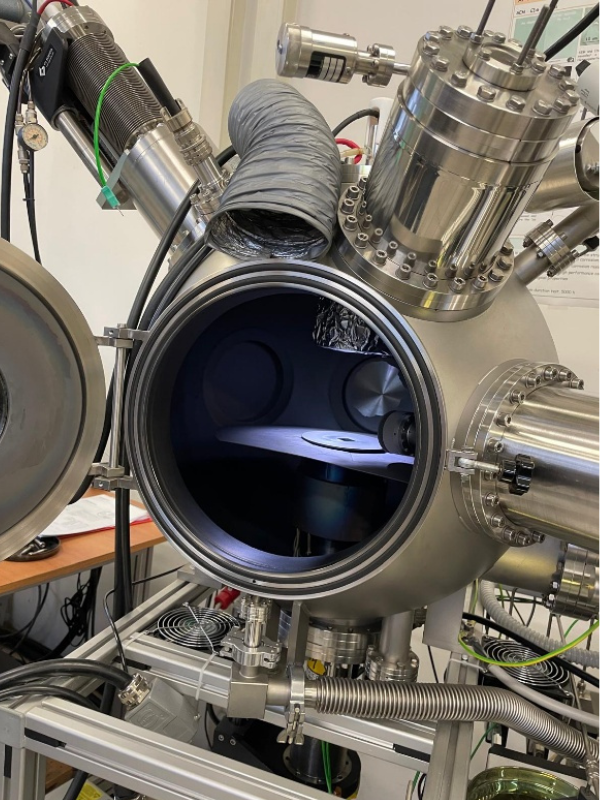
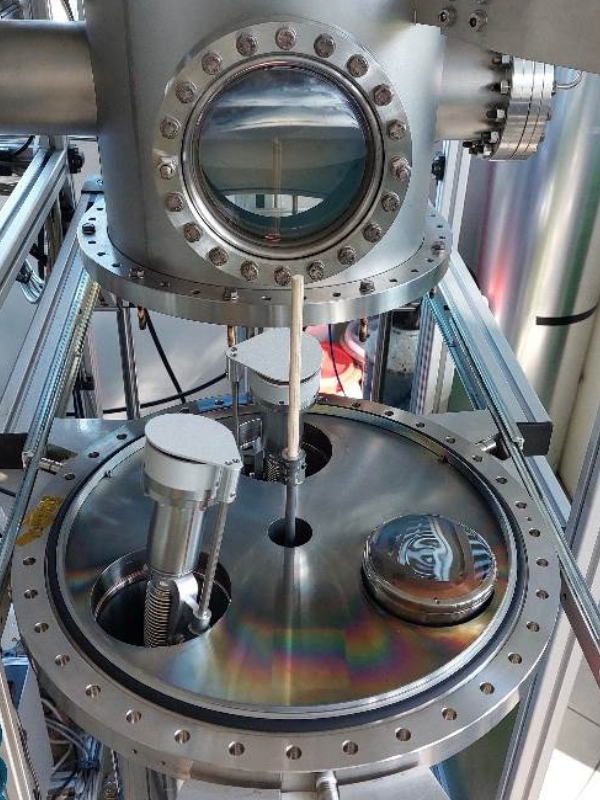
The systems employ multiple plasma excitation modes (DC, pulsed DC, RF, and HiPIMS) combined with substrate biasing to control film growth and microstructure, enabling metallic and ceramic coatings on complex geometries.
Magnetron Sputtering Modes
Radio Frequency (RF-MS)
Stable deposition from insulating materials. Strengths: Direct sputtering of ceramics; high film quality; wide process window.
Direct Current (DC-MS)
Continuous voltage for conductive targets. Strengths: Robust process; high deposition rates; excellent uniformity.

Pulsed DC Magnetron Sputtering (pDC-MS)
Voltage reversal (10–350 kHz) improves stability in reactive atmospheres and suppresses arcing. Tuning pulse frequency allows additional control over film growth.
HiPIMS – Unipolar Mode
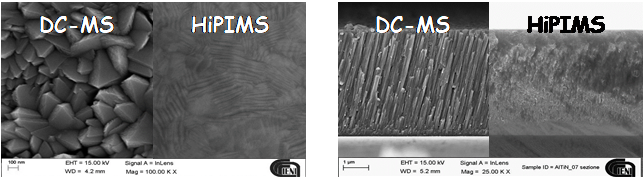
Short, high-power pulses generate dense plasmas. Strengths: Dense coatings, smooth morphology, and enhanced adhesion due to ion bombardment.
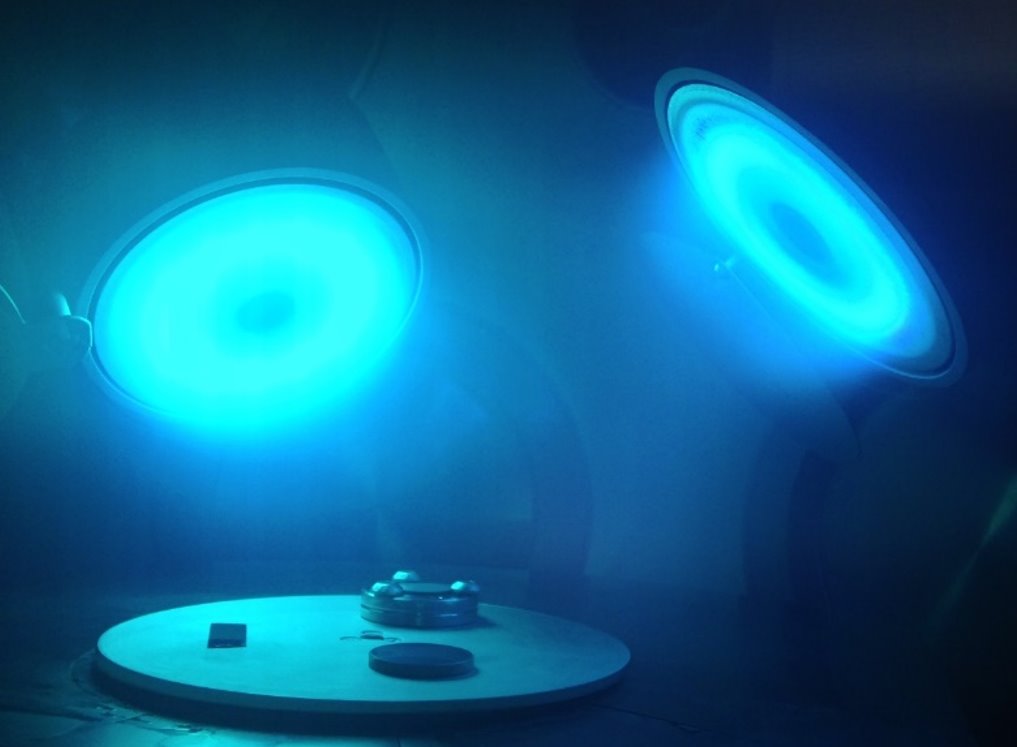
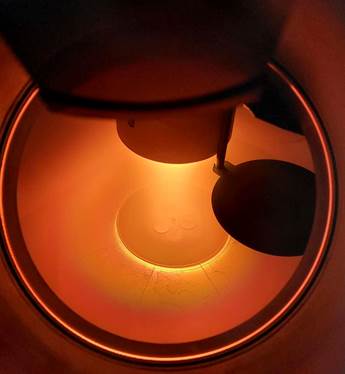
Plasma discharge during the deposition of a PVD film
HiPIMS – Bipolar Mode
A positive pulse acceleration of metal ions toward the substrate. Strengths: Species-selective acceleration and improved texture control.
Plasma Surface Treatments
Support for sputter cleaning and plasma nitriding. Promotes efficient oxide removal and defect-free interfaces.
Hybrid Operation & Instrumentation
Hybrid Multimode: HiPIMS + DC/RF operation combines quality with high throughput. Diagnostics: V-I traces, Hall sensors, and optical emission monitoring.
Info & Contacts
- Silvia Maria Deambrosis – silviamaria.deambrosis@cnr.it
- Enrico Miorin – enrico.miorin@cnr.it
×
![Enlarged view]()
PVD MAGNETRON SPUTTERING LAB
Padua
The laboratory operates three independent physical vapor deposition (PVD) platforms for the development of advanced functional coatings for components exposed to extreme service conditions, including high temperatures, aggressive environments, and severe wear and friction. Applications span power generation, turbomachinery, nuclear and marine systems, and biomedical devices.
The systems employ multiple plasma excitation modes (DC, pulsed DC, RF, and HiPIMS) combined with substrate biasing to control film growth and microstructure, enabling the deposition of dense metallic and ceramic coatings on both conductive and insulating substrates, including complex geometries.
In addition to thin film deposition, the platforms support plasma-assisted surface treatments such as nitriding and plasma etching for surface activation and modification. Flexible deposition geometries, together with substrate heating, motion, and real-time plasma diagnostics, allow precise control of coating architecture and process conditions.
Radio Frequency Magnetron Sputtering (RF-MS)
In RF sputtering, an alternating electric field (13.56 MHz) prevents charge accumulation on the target, enabling stable deposition from insulating or dielectric materials.
Strengths
- Direct sputtering of dielectric materials (oxides, nitrides, ceramics) with stable plasma conditions
- Good stoichiometric control and high film quality
- Wide process window and good thickness uniformity
Typical applications
Deposition of optical and dielectric films requiring high homogeneity and precise composition control.
DC Magnetron Sputtering (DC-MS)
In DC mode, a continuous negative voltage is applied to a conductive target to sustain a stable magnetron discharge. The sputtered flux is predominantly neutral (ionized fraction ~1%).
Strengths
- Robust and stable process with excellent thickness uniformity over large areas
- High deposition rates for conductive targets due to efficient electron confinement
- Well suited for metallic films where strong ion bombardment is not required
Typical applications
Deposition of pure metals, adhesion layers, and functional metallic coatings where process simplicity and high throughput are key advantages.
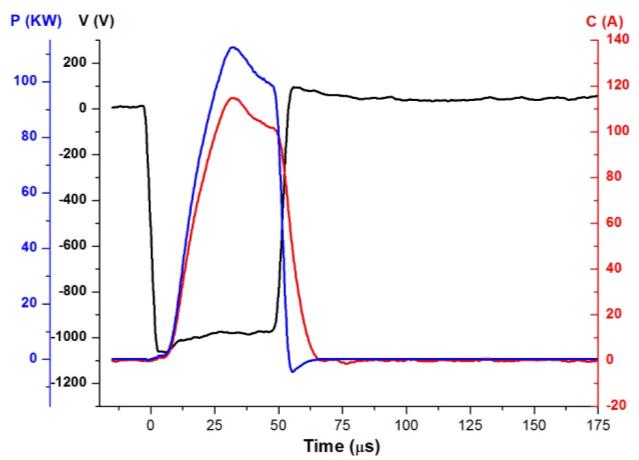
Typical signals related to different magnetron sputtering technologies
Pulsed DC Magnetron Sputtering (pDC-MS)
Pulsed DC sputtering is a variant of DC magnetron sputtering where the applied voltage is periodically reversed or interrupted (typically 10–350 kHz), improving plasma stability in reactive atmospheres and during deposition of charge-accumulating materials.
Strengths
- Suppresses arcing and improves stability in reactive gas mixtures
- Enables higher deposition rates in reactive sputtering processes
- Allows additional control of film growth by tuning pulse frequency, width, and duty cycle
Typical applications
Reactive sputtering of metallic targets to form compound coatings (e.g., nitrides or oxides) and stable operation in dual-magnetron configurations where improved plasma stability is required.
High Power Impulse Magnetron Sputtering (HiPIMS) – Unipolar Mode
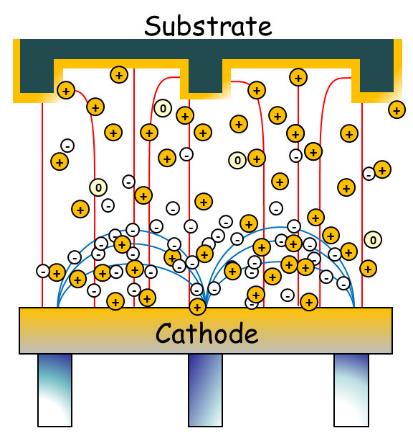
HiPIMS uses short, high-power pulses (tens to hundreds of microseconds, low duty cycle) to generate extremely dense plasmas with a highly ionized metal flux, far exceeding conventional DC or pulsed DC sputtering. Substrate biasing can be applied and synchronized with the pulse to control ion energy during film growth.
Strengths
- Dense, low-porosity coatings with smooth morphology
- Enhanced adhesion due to energetic ion bombardment and interfacial mixing
- Tailored microstructure, stress, and hardness through ion energy control
- Improved conformality on complex geometries
Typical applications
High-performance coatings requiring dense microstructures, strong adhesion, and controlled properties, including hard coatings, protective layers, and advanced functional films.
Plasma discharge during the deposition of a PVD film
HiPIMS – Bipolar Mode
In bipolar HiPIMS, a short positive pulse follows the main negative pulse, generating a transient potential structure that accelerates metal ions toward the substrate even without external bias.
Strengths
- Additional control of ion energy and arrival timing
- Narrow ion energy distributions and species-selective acceleration
- Enhanced densification and improved control of texture, stress, and hardness
Typical applications
Advanced hard coatings and ceramic films where precise ion energy control is required to tailor microstructure and mechanical properties.
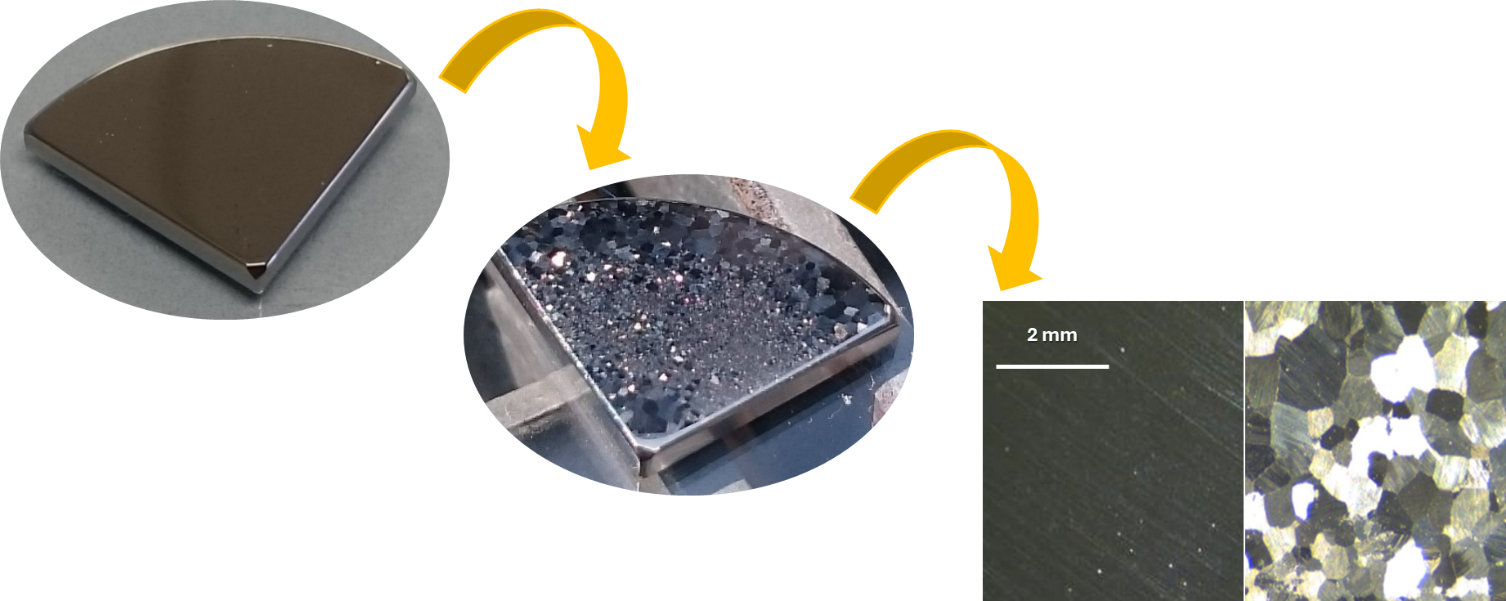
Result of an etching treatment on an AlTi alloy
Plasma Surface Treatments
The platforms support plasma-assisted surface treatments, including sputter cleaning, surface activation, and plasma nitriding. When operated in HiPIMS mode, the highly ionized pulsed plasma promotes efficient oxide removal, interfacial mixing, and the formation of dense, defect-free interfaces prior to coating deposition.
Strengths
- Efficient surface cleaning and activation through metal-ion-rich plasma flux
- Improved film adhesion compared with conventional Ar ion etching
- Plasma nitriding with enhanced nitrogen ion formation, enabling faster processing and the formation of hard, wear- and corrosion-resistant nitride layers
Hybrid & Synchronized Multimode Operation
The systems allow simultaneous operation of different sputtering modes on multiple magnetrons (e.g., HiPIMS + DC/pulsed DC or HiPIMS + RF), enabling hybrid deposition processes and co-sputtering strategies.
Strengths
- Higher deposition rates while retaining the film quality typical of HiPIMS
- Flexible multi-cathode configurations for complex coatings and multilayers
- Advanced process control through synchronized pulsed power and substrate bias
Instrumentation & Control
- Thermal and electrical control: substrate heating and biasing widen the process window for film densification and phase control.
- Real-time electrical diagnostics: V–I traces and substrate current (Hall sensors, differential probes, oscilloscopes) enable pulse‑resolved tuning and arc management.
- Optical plasma diagnostics: optical emission monitoring tracks relative line intensities to indirectly estimate the ionized plasma fraction.